

Setting up a real fitness routine when you work full-time, take care of a family, or run around all day feels almost impossible. Most workout programs ask you to spend two hours in the gym six days a week. That works for professional athletes, but it fails regular people with busy lives.
You do not need to live in the gym to get strong, lose fat, and feel energetic. At ffmi calculator, we look at body composition using smart math rather than quick fixes. Your body responds to quality training, proper recovery, and consistency.
Build a Fitness Routine this guide breaks down exact steps to design a working workout schedule. You will learn how to fit exercise into tiny time slots, track real progress with our ffmi calculator, avoid burning out, and keep your routine running smoothly year-round.
Why Most Busy People Fail at Exercise
Most fitness advice tells you to go all-in right away. People get excited on Sunday night, sign up for a hard routine, buy new shoes, and promise to work out for ninety minutes every morning. By Wednesday afternoon, work gets busy, sleep suffers, and the plan falls apart.
The real problem is not a lack of willpower. The problem is choosing an unrealistic plan. When you try to change your entire life overnight, any small schedule disruption ruins your momentum.
Unrealistic Plan (6 Days / 2 Hours Daily)
  └─> Missed Session due to Work/Family
       └─> Guilt & Stress
            └─> Total Plan Failure

Realistic Plan (3 Days / 30 Minutes Daily)
  └─> Missed Session gets moved easily
       └─> Consistency remains high
            └─> Long-term Results
Exercise should support your daily life, not fight against it. Building a routine that fits your calendar keeps you consistent for months and years. Consistency is what actually changes your body shape, health numbers, and daily energy.
| Common Mistake | Why It Breaks Down | The Smart Fix |
| Copying a pro bodybuilder plan | Requires 10 to 12 hours weekly | Use 30-minute full-body sessions |
| Thinking cardio is the only path | Takes hours and burns muscle | Focus on compound strength lifts |
| Waiting for the “perfect time” | Work schedules always change | Schedule workouts like doctor appointments |
| Ignoring body composition | Scale weight drops, but muscle lost | Use our ffmi calculator to track lean mass |
The Math Behind Building Muscle and Burning Fat
Before picking exercises, you need to understand how your body changes. Many people focus only on scale weight. If the scale goes down, they think they are winning. But losing weight often means losing valuable muscle tissue alongside fat.
This is where your Fat-Free Mass Index comes into play. While standard Body Mass Index looks at total weight compared to height, it cannot tell the difference between fat mass and muscle mass. Someone who lifts heavy weights might weigh the same as someone who never exercises, yet their health profiles are completely different.
$$\text{FFMI} = \frac{\text{Fat-Free Mass (kg)}}{\text{Height (m)}^2}$$
Using our ffmi calculator lets you track pure lean muscle mass over time. When your workout routine is working well, your lean muscle score stays stable or moves upward, even while your body fat drops.
According to guidelines from the World Health Organization, adults need at least 150 minutes of moderate movement or 75 minutes of vigorous exercise each week, combined with strength work on two or more days. Breaking those targets into manageable chunks protects your health without overwhelming your daily planner.
Total Body Weight
 ├── Fat Mass (Stored energy)
 └── Fat-Free Mass (Muscles, Bones, Organs, Water)
      └── Measured precisely using ffmi calculator
Research published by the National Institutes of Health confirms that strength training preserves vital lean body tissue during periods of busy work schedules and calorie control. Keeping muscle mass maintains your background metabolic rate, making long-term health far easier to maintain.
Finding Hidden Time Slots in Your Daily Schedule

The most common reason people miss workouts is a lack of time. Yet most adults spend hours every day on low-priority activities without realizing it. Finding time for physical fitness does not require clearing out half your day.
Start by looking closely at your weekly schedule. Look for small pockets of fifteen to thirty minutes that usually slip away.
- Early Morning Window: Wake up thirty minutes earlier. A short workout before your day starts guarantees that unexpected meetings won’t cancel your session.
- Lunch Break Push: Use half of your work lunch hour for a fast circuit workout or brisk walk outside.
- Transition Slot: Work out immediately after your workday ends, before sitting down on the couch or turning on the TV.
| Time Window | Best Workout Type | Main Advantage |
| 6:30 AM – 7:00 AM | Bodyweight Strength / Dumbbells | Gets completed before distractions happen |
| 12:30 PM – 1:00 PM | Fast Kettlebell Circuit | Boosts afternoon energy and focus |
| 5:30 PM – 6:00 PM | Heavy Strength Training | Helps relieve job stress after work |
When you treat your workout time like an important business meeting, you protect it. Put your exercise blocks directly onto your personal calendar.
Designing efficient Full-Body Workouts Build a Fitness Routine
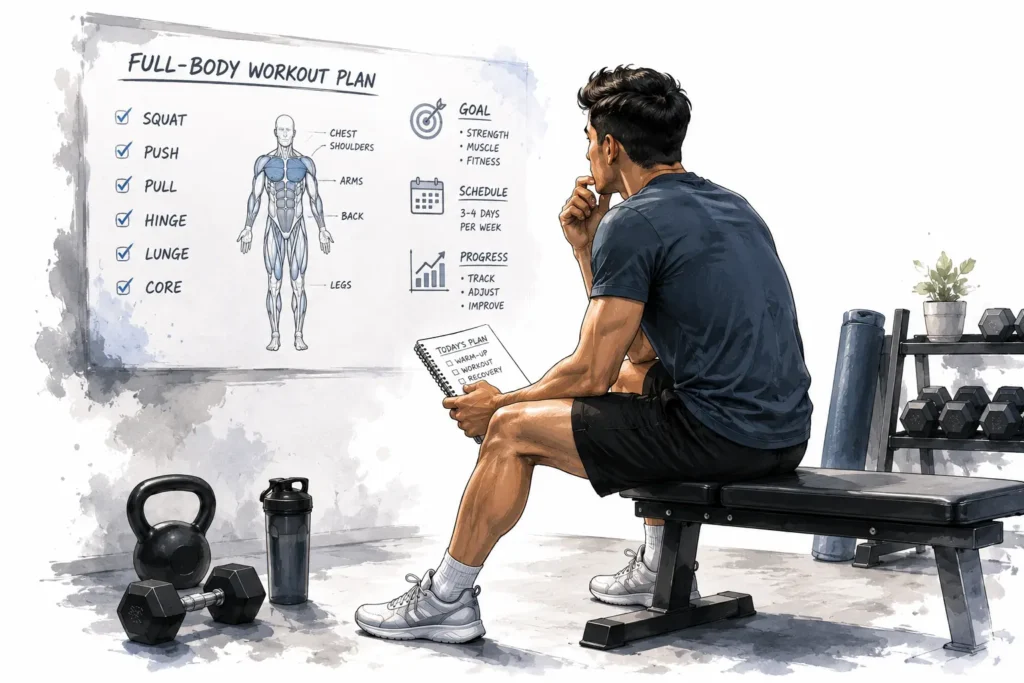
When your weekly calendar is tight, split routines (like training chest on Monday, back on Tuesday, and legs on Wednesday) are inefficient. If you miss Tuesday’s workout, an entire muscle group gets left behind for two weeks.
Full-body workouts solve this issue completely. By training your entire body three times a week, every muscle group gets stimulated regularly. If life interferes and you miss a day, you still hit every muscle earlier or later in the week.
Full-Body Structure (3 Days / Week)

  [ Squat / Push / Pull ]  ──>  Rest Day  ──>  [ Hinge / Press / Row ]
         (Monday)                                  (Wednesday)
Focus on large multi-joint movements. These exercises recruit multiple muscles at once, burning maximum energy in minimal time.
- Squat Movements: Goblet squats, barbell back squats, or bodyweight lunges work your thighs, hips, and core.
- Hinge Movements: Romanian deadlifts, kettlebell swings, or hip thrusts target your glutes and hamstrings.
- Pushing Movements: Overhead presses, dumbbell chest presses, or classic push-ups build your shoulders, chest, and triceps.
- Pulling Movements: Dumbbell rows, inverted bodyweight rows, or lat pulldowns strengthen your upper back and biceps.
By combining one exercise from each category into a single session, you get a full-body workout in under thirty minutes.
Setting Up Your Weekly Exercise Split
Choosing the right schedule depends entirely on your real-life commitments. Below are three practical workout structures designed for busy calendars.
Option A: 3-Day Full-Body (30–45 Mins)
Mon: Workout A  | Tue: Rest | Wed: Workout B | Thu: Rest | Fri: Workout C | Sat/Sun: Rest

Option B: 4-Day Upper/Lower Split (30 Mins)
Mon: Upper Body | Tue: Lower Body | Wed: Rest | Thu: Upper Body | Fri: Lower Body | Sat/Sun: Rest

Option C: 15-Minute Daily Express
Mon thru Fri: 15-Min Focused Circuit | Sat/Sun: Active Recovery Walks
Option A: The Three-Day Full-Body Plan
This is the gold standard for busy adults. You train hard three times per week on non-consecutive days, such as Monday, Wednesday, and Friday.
On your rest days, you simply walk or stretch. This approach leaves four full days open for family, hobbies, and work demands while ensuring continuous muscle stimulation.
Option B: The Four-Day Upper/Lower Split
If you prefer shorter sessions more days per week, split your body into upper-body and lower-body workouts. You train upper muscles on Monday and Thursday, and lower muscles on Tuesday and Friday.
Each session takes only twenty to thirty minutes because you are covering fewer muscle groups at once.
Option C: The Fifteen-Minute Daily Express
When life gets extremely chaotic, long workouts are unrealistic. You can maintain your hard-earned muscle mass by doing brief fifteen-minute bodyweight or dumbbell circuits five days a week.
While this plan will not turn you into a elite powerlifter, it will protect your lean mass and keep your metabolic health strong until your schedule opens back up. You can check your progress using our ffmi calculator to verify that your muscle mass remains intact during busy periods.
Simple Home Workouts Without Expensive Gear
You do not need an expensive gym membership to build a strong body. Driving to a fitness center, finding parking, changing clothes, and driving back can add forty minutes to your workout. Training at home removes friction and saves precious time.
A basic set of adjustable dumbbells or resistance bands gives you everything needed for a challenging session.
Home Setup Essentials:
  ├── Pair of Adjustable Dumbbells (or Resistance Bands)
  ├── Comfortable Floor Mat
  └── Pull-Up Bar or Sturdy Chair
Here is a simple, effective home workout routine requiring minimal equipment:
- Dumbbell Goblet Squats: 3 sets of 10 to 12 repetitions
- Dumbbell Floor Press: 3 sets of 10 to 12 repetitions
- Single-Arm Dumbbell Rows: 3 sets of 12 repetitions per side
- Dumbbell Romanian Deadlifts: 3 sets of 12 repetitions
- Plank Hold: 3 sets holding for 30 to 45 seconds
Take forty-five seconds of rest between sets. This entire workout takes roughly twenty-five minutes from start to finish.
For authoritative guidelines on exercise safety, movement standards, and baseline fitness advice, consult resources provided by the Mayo Clinic and Harvard Health Publishing.
How to Eat Right When Time Is Limited
Exercise provides the signal for your body to adapt, but food supplies the building blocks. If you eat poorly, your body struggles to repair muscle tissue, leading to fatigue and poor results.
Nutrition does not need to be complicated or time-consuming. Focus on three main habits to keep your nutrition on track during busy weeks.
Daily Meal Structure:
  [ Lean Protein Source ] + [ Whole Food Carbs ] + [ Healthy Fats / Vegetables ]
- Prioritize Protein First: Protein supports muscle recovery and keeps you feeling full. Aim to include a palm-sized portion of protein with every main meal, such as chicken, eggs, fish, tofu, or Greek yogurt.
- Keep Prep Simple: Cook large batches of basic foods on days when you have extra time. Baking several chicken breasts, roasting a tray of vegetables, and cooking a batch of rice takes less than an hour and provides meals for days.
- Smart Convenience Foods: Keep healthy convenience options on hand for emergencies. Frozen vegetables, canned tuna, pre-cooked grain pouches, and plain protein powders save time while keeping your nutrition clean.
Tracking your physical changes with our ffmi calculator helps confirm whether your current diet provides enough fuel to retain muscle while shedding body fat.
Avoiding Overuse Injury and Mental Burnout
When time is short, it is tempting to push hard every single minute of your workout. However, working out at maximum intensity while sleeping poorly and carrying high job stress increases your injury risk.
Your body builds muscle and burns fat during rest, not during the workout itself. The workout creates the stimulus; rest enables the recovery.
Stress Balance Equation:
  (Work Stress + Family Stress + Heavy Workouts) - Adequate Rest = Burnout / Injury
  (Work Stress + Family Stress + Smart Workouts) + Adequate Rest = Adaptation / Growth
Pay attention to these signals that your routine is too aggressive for your current lifestyle:
- Persistent joint pain or heavy muscle soreness that lasts more than three days
- Difficulty falling asleep or staying asleep at night
- Drops in daily workplace productivity and overall mood
- Lack of progress on your key strength lifts over several weeks
When you spot these warning signs, take a light week. Cut your weights in half or reduce your workout times by ten minutes. Giving your nervous system room to recover allows you to resume making progress without missing weeks due to injury.
Measuring Real Progress Beyond the Bath Scale
Relying solely on a traditional bathroom scale can destroy your motivation. Scale weight shifts constantly due to water retention, salt intake, digestion, and stress hormones. A heavy workout can cause your body to hold extra water for repair, making the scale go up even when you lost body fat.
To track true progress, combine three practical measurement tools:
Progress Tracking Framework:
  ├── Primary: ffmi calculator (Tracks muscle development)
  ├── Secondary: Body Circumference Tape (Waist, Chest, Arms)
  └── Daily: Performance Logs (Weights lifted, Reps completed)
Our ffmi calculator separates weight changes into lean tissue and fat mass. If your scale weight stays flat while your normalized FFMI rises, you are gaining functional muscle while losing unwanted body fat. This structural recomposition is the ultimate goal of any well-designed fitness routine.
Also, track your exercise logs. If you can lift a weight for ten reps today that you could only lift for eight reps two weeks ago, your muscular system is growing stronger regardless of what the bathroom scale says.
Frequently Asked Questions
Can I get real results with just twenty-minute workouts?
Ans: Yes. Short workouts are effective if you keep your effort high and minimize rest time between exercises. Focus on compound movements like squats, push-ups, and rows.
How many days per week should a beginner train?
Ans: Starting with two or three days per week is ideal for beginners. This schedule leaves plenty of time for recovery while building a consistent habit that fits into a busy lifestyle.
Should I do cardio or weight lifting if I only have limited time?
Ans: Prioritize weight lifting or bodyweight strength exercises. Strength training protects your lean muscle mass and improves body composition faster than steady-state cardio. You can add fast walking during daily calls or breaks for extra aerobic health.
How often should I recalculate my FFMI?
Ans: Calculate your numbers every four to six weeks. Muscle tissue grows slowly, so checking your score too often can lead to confusion from temporary water fluctuations.
What should I do if work gets crazy and I miss an entire week?
Ans: Do not panic or try to perform extra long workouts to make up for missed time. Simply resume your normal routine at a light intensity as soon as your schedule clears up. Consistency over months matters far more than a single missed week.
A Simple Strategy for Long-Term Success

Ans: Fitting exercise into a hectic week comes down to dropping absolute perfection in favor of consistent effort. You do not need two-hour gym sessions, complex split plans, or extreme diets to build a healthy body.
Focus on three short, full-body sessions per week using basic compound movements. Keep your meal prep simple, protect your sleep quality, and track your actual body composition changes over time with our ffmi calculator.
By treating fitness as a manageable part of your daily routine rather than an all-consuming chore, you create a sustainable habit that keeps you strong, lean, and energized for life.